TWO:The opening of the campaign on the Rhine in 1797 restored the positions of the French. On the lower part of the river, Hoche, who now commanded them, defeated General Kray; on the upper Rhine Moreau retook the fortress of Kehl,[459] opposite to Strasburg; and such was the alarm of Austria that she began to make overtures of peace. The fortunes of her army in Italy made these overtures more zealous; Alvinzi was defeated at Rivoli on the 14th of January, and Provera soon after surrendered with four thousand men, and Wurmser capitulated at Mantua. The Archduke Charles was now sent into Italy with another army, but it was an army composed of the ruins of those of Beaulieu, Alvinzi, Wurmser, and Davidowich, whilst it was opposed by the victorious troops of Buonaparte, now supported by a reinforcement of twenty thousand men under Bernadotte. The archduke, hampered by the orders of the Aulic Council in Vienna, suffered some severe defeats on the Tagliamento in March, and retreated into Styria, whither he was followed by Buonaparte. But the danger of a rising in his rear, where the Austrian General Laudon was again collecting numerous forces, induced Buonaparte to listen to the Austrian terms for peace. The preliminaries were signed on the 18th of April at Leoben, and Buonaparte, to bind the Emperor to the French cause, and completely to break his alliance with Britain, proposed to hand over to the Austrians the territory of Venice. This being effected, Buonaparte hurried back to seize and bind the promised victim. He took a severe vengeance on the people of Verona, who had risen against the French in his absence, and then marched to Genoa, where, under pretence of supporting the people in their demands for a Republic, he put down the Doge and Senate, set up a democratical provisional government, seized on all the ships, docks, arsenal, and stores¡ªin fact, took full possession. All further pretence of regard for the neutrality of Genoa was abandoned.As this rout was taking place, Bulow, who had beaten back the French battalions from Frischermont and Planchenoit, was approaching La Belle Alliance, and Blucher with the main army soon after appeared following him. At a farmhouse called Maison Rouge, or Maison du Roi, behind La Belle Alliance, the Duke of Wellington and Blucher met and felicitated each other. Blucher, in the Continental manner, embraced and kissed the victorious Duke; and it was agreed that, as the army of Wellington had been fighting hard for eight hours, the Prussians should make the pursuit. Blucher swore that he would follow the French whilst a horse or a man could move, and, with three cheers from the British, he set forward with his troops in chase. So far from "the Guards dying, but not surrendering," these brave men flew now before the stern old Prussian, and immediately in the narrow passage at Genappe they abandoned to him sixty pieces of their cannon. Amongst other spoil they captured the carriage of Napoleon, and found in it, amongst other curious papers, a proclamation for publication the next day at Brussels. As it was moonlight, the Prussians continued the chase till late into the night, slaughtering the fugitives like sheep. Numbers quitted the road and fled across the country, seeking shelter in the woods, where many of them were afterwards found dead or severely wounded. The highway, according to General Gneisenau, was covered with cannon, caissons, carriages, baggage, arms, and property of every kind. The wounded were humanely sent to Brussels, but those who could continue their flight did so till they had reached France, where they sold their horses and arms, and dispersed themselves to their homes. The grand army was no more, with the exception of the division of Grouchy, who made good his retreat to Paris, only to be upbraided by Buonaparte as the cause of his defeat. In this battle and retreat the French lost more men than at Leipsic, the killed and wounded exceeding thirty thousand.
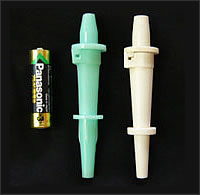
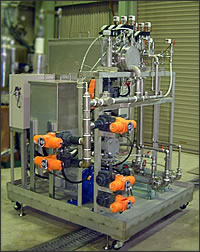
A hydrocyclone (liquid cyclone) injects treatment solution into stationary equipment to perform separation, classification, and concentration, and is an innovative separator with a very simple structure and no drive unit.
Structure of a hydrocyclone (liquid cyclone)
A suspension containing fine particles of several micrometers or more is supplied to a cylindrical container circumferentially at high speed. And as a result it starts to rotate and a centrifugal force is generated. At this time a gravitational acceleration of several tens of thousands of G is generated in the circumferential direction, and thus leading to fast sedimentation and concentration of the fine particles. The separated concentration can be freely selected by changing the supply rate (supply pressure and flow rate) and the flow ratio of the outlet. Our hydrocyclone (liquid cyclone) was designed and manufactured to classify and concentrate fine particles, and so has a small element.
THREE:
- Equipment costs can be reduced.
- Operating costs can be reduced.
- Maintenance costs can be reduced.
- Any change in raw material and product can be easily addressed.
- Large amounts can be treated in a small area.
- Separation and cleaning are easy because of the simple structure.
- Simplified control
- This equipment can be operated in synchronization with external devices.
- Alarm and interlock mechanism.
THREE:He first published an engraving of "The Small Masquerade Ticket, or Burlington Gate," in ridicule of Lord Burlington's architecture, and of Pope's eulogiums on Burlington and satire of the Duke of Chandos. He illustrated "Hudibras," and produced a satirical plate, "The Taste of the Times," in 1724; and, some years after, "The Midnight Conversation" and "Southwark Fair." Not content with the fame which this vein, so peculiarly his own, was bringing him, he had the ambition to attempt the historical style, but this was a decided failure. In 1734, however, he came out in his full and peculiar strength in "The Harlot's Progress." The melancholy truth of this startling drama, mingled with touches of genuine humour, seized at once on the minds of all classes. It became at once immensely popular; it was put on the stage, and twelve hundred subscriptions for the engravings produced a rich harvest of profit. In the following year he produced "The Rake's Progress," which, though equally clever, had not the same recommendation of novelty. In 1744 he offered for sale the original paintings of these subjects, as well as "The Four Times of the Day," and "The Strolling Actresses Dressing in a Barn;" but here he felt the effects of the sturdy English expression of his sentiments on art, and his distributing of an engraving of "The Battle of the Pictures," as a ticket of admission, gave great offence to painters and their patrons. The whole sum received was only four hundred and twenty-seven pounds. Undaunted by his self-injuring avowal of his opinions, he offered in 1750 the pictures of "Marriage ¨¤ la Mode" for sale, but put forth an advertisement in such caustic terms, as he reflected on the result of his former auction, that he effectually kept away purchasers, and obtained only a hundred and twenty pounds for what Mr. Angerstein afterwards gave a thousand pounds for. His "March to Finchley" being sent for the royal inspection, so impressed George II. with the idea that it was a caricature of his Guards, that, though the engraving of it was dedicated to him, he ordered the picture out of his sight, with expressions of great indignation. Hogarth quietly substituted the name of the King of Prussia in the dedication, as "an encourager of the arts."
- Classification and concentration for the manufacture of inorganic powder materials
- Classification of ceramic materials
- Removal of fine particles, including iron powder
- Removal of fine particles from pigments
- Removal of fine organic particles from solvents
- Separation of starch and yeast
- Removal of fine particles from high-temperature strong acid solutions
- Removal of fine particles from low-temperature solutions